Boreal Landscapes - Christina Lake
|
|
Data PortalData type: Camera data Camera sites: 60 Area: 3500 km2 Timespan: Continuously 2011-2014; redeployed at the same sites 2017-2020. Camera data and models: Downloadable at Dryad. Landcover data: Available from the ABMI's Human Footprint Database. Metadata: See Publications, below. |
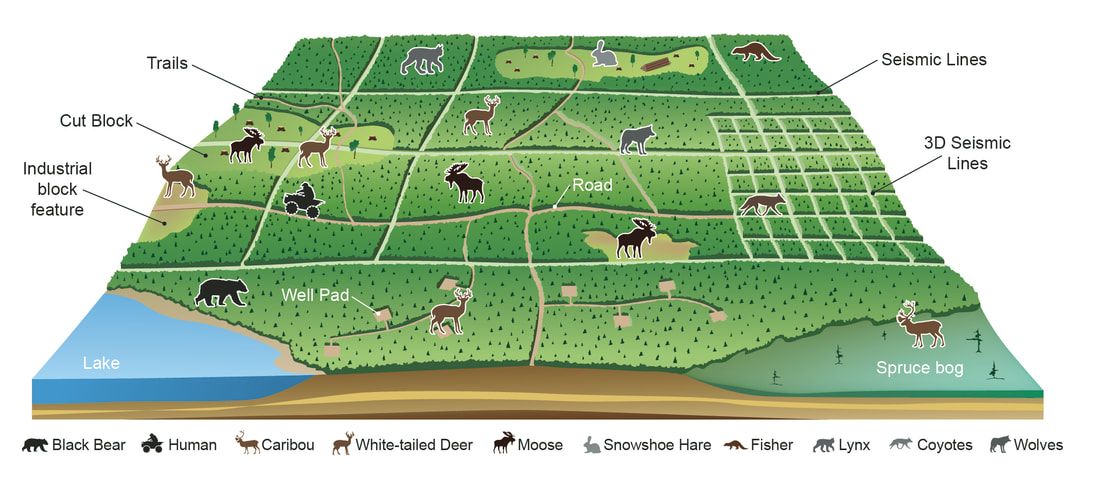
Christina Lake is a region of boreal forest northeast of Lac La Biche, Alberta, Canada., and part of the Canadian Oil Sands. This rich play generates substantial petroleum products, important economically. It is also a landscape ecology "petri dish", as the landscape is marked with unique shapes and features and a (nearly) intact boreal forest mammal community. This landscape has been the heart of our boreal program with six years of data collection to date, several publications, and international media coverage.
Take a digital flight over this amazing landscape! Click here to launch.
See our growing list of publications on this landscape below.
Take a digital flight over this amazing landscape! Click here to launch.
See our growing list of publications on this landscape below.
|
Associated Publications
Wittische, J., S. Heckbert, P.M.A. James, A.C. Burton, and J.T. Fisher. 2021. Community-level modelling of boreal forest mammals in an oil sands landscape reveals how human disturbance, natural habitat, and predation shape mammal distribution. Science of the Total Environment 755(2): 142500. Fisher, J.T., and A.C. Burton. 2020. Spatial structure of reproductive success infers mechanisms of ungulate invasion in Nearctic boreal landscapes. Ecology & Evolution 11(2): 900-911. Fisher, J.T., A.C. Burton, L. Nolan, and L. Roy. 2020. Influences of landscape change and winter severity on invasive ungulate persistence in the Nearctic boreal forest. Scientific Reports 10: 8742 Media coverage: CBC, Canada News Media, International Affiliates Fisher, J.T., and A.C. Burton. 2018. Wildlife winners and losers in an oil sands landscape. Frontiers in Ecology and Environment, 16(6): 323-328. Burgar, J.M., J.P. Volpe, J.T. Fisher, and A.C. Burton. 2018. The importance of considering multiple interacting species for conservation of species at risk. Conservation Biology, 33(3): 709-715. |
|